
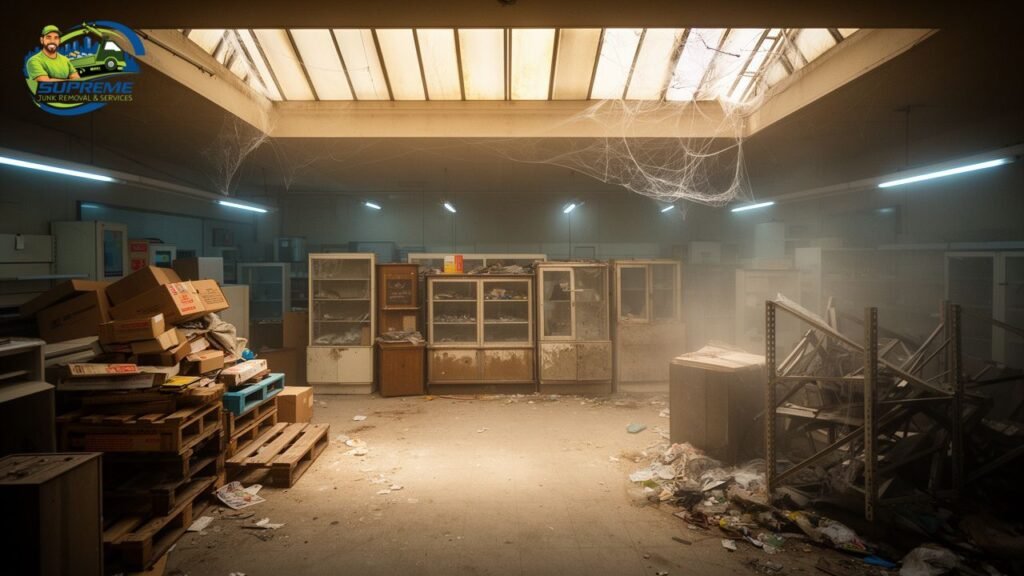
Leases end on a date. Landlords want the space broom clean. Somehow in the middle of it all, a business owner is standing in his empty store staring down forty feet of gondola shelving, wondering who in the world is going to remove it. A retail store cleanout is seldom a timely affair, especially when vacating a leased location.
The scale of this problem is bigger than most owners realize until they’re living it. The EPA’s data on construction and demolition debris puts U.S. C&D waste at roughly 600 million tons in 2018 alone, more than double the volume of ordinary municipal trash, and store renovations and closures feed that pile steadily, year after year.
Why a shelving unit is harder to remove than it looks
A gondola shelving unit isn’t a couch you carry out in two trips. Most retail shelving is mounted Most retail shelving is mounted to wall track systems, and improper removal can damage drywall or the anchors a landlord may want to reuse.
I think you have to install them on the studs, and not on the drywall. The glass display case is much heavier than it appears, and that would be an expensive surprise if it were to shatter while trying to remove it.
There’s also the sorting problem, and it’s a real one. A mid-size retail space closing out might have wood shelving that’s donatable, steel racking with actual scrap value, electronics like POS terminals and security cameras that need separate handling entirely, and mixed-material displays that are just trash, plain and simple.
Treat all of it the same way, either donating everything or dumpstering everything, and it costs money in one direction and wastes usable material in the other.
The inventory walkthrough that saves money later
Simple in theory. It’s also the step almost every owner skips, because they’re focused on the lease deadline and not much else, and skipping it is usually what turns a retail store cleanout into a pure cost instead of something that partially pays for itself.
Wood and laminate shelving in decent shape sells reasonably well through fixture resale dealers and used restaurant or retail equipment brokers, especially name-brand gondola systems from manufacturers like Lozier or Madix. Steel racking, wire shelving, and metal display frames carry scrap value even when they’re too beat up to resell.
A local scrap yard will weigh and pay for it the same day, no appointment necessary in most cases.
Retail Shelving Removal: Getting Shelving Out Without Damaging the Space
Retail shelving removal is where most DIY cleanouts burn through their timeline, especially when fixtures are bolted into walls or floor systems. A handful of things actually change the outcome here:
Photograph the layout before disassembly starts. If shelving is being resold or relocated to another store, reassembly goes a lot faster with reference photos in hand.
Empty and remove the adjustable shelves before touching the frame itself. A loaded gondola unit needs two people at minimum to lift; an empty one often doesn’t.
Check whether wall mounted slatwall or pegboard is glued or mechanically fastened before attempting to remove any piece by prying. Pull a glued panel off the wrong direction, and you’ll take the drywall paper with it; patching it up is a chore that a landlord is likely to deduct from your security deposit.
Bag and label hardware, screws, brackets, wall anchors separately if any of these items are to be stored for later use. Missing hardware is one of the more common reasons stored fixtures end up scrapped down the road instead of getting reinstalled.
The equipment people forget until it’s a problem
Shelving gets the attention because it’s the biggest visual job in the room. But store equipment disposal usually includes items that need entirely different handling, and this is where cleanouts run into fines or delays that nobody saw coming.
Refrigeration units, if the store had a beverage cooler, deli case, or frozen section, contain refrigerants regulated under the Clean Air Act. They can’t just go in a dumpster. A certified technician has to recover the refrigerant first, and most municipalities want documentation of that recovery before they’ll take the unit.
Security systems, including CCTV cameras and alarm panels, often have leftover data sitting on local storage drives. Wiping or physically destroying that storage media matters quite a bit if the store ever processed customer payment information.
Signage is its own category of trouble. Illuminated signs sometimes contain ballasts with older components that need separate handling depending on age and manufacturer, and exterior signage removal may also require a permit from the local building department. Altering a storefront facade, even by removing something, can fall under local sign ordinances in plenty of towns.
Deciding what’s worth donating
Donating fixtures sounds like the responsible default, and often it is the right call. But it only works if some specific conditions are met. Most nonprofits and reuse organizations are looking to acquire things that are all functional, reasonably clean, and not too difficult to transport for their volunteers.
A Habitat for Humanity ReStore will typically take shelving units, display racks, and some commercial furniture. Most locations, though, cap how much they’ll accept per visit and won’t handle anything that needs disassembly on-site by their own staff.
Timing is usually where donation falls apart. Nonprofit pickup schedules run on their own calendar, often two to three weeks out, which doesn’t line up well when a landlord wants the space empty in five days. If the lease deadline is tight, donation can still work for a portion of the fixtures pulled early, with whatever’s left going to resale or scrap on whatever compressed timeline the lease actually allows.
Retail is closing locations faster than it’s opening them. Coresight Research tracked 8,270 store closures across the U.S. in 2025 against just 5,270 openings, a net loss of about 3,000 stores in a single year. Every one of those closures leaves behind shelving, checkout counters, signage, and equipment that has to go somewhere, and “somewhere” is rarely as simple as a dumpster.
Cleanouts that happen alongside a renovation, not a closure
Not every job is a closing store. A business undergoing retail renovation cleanup while staying open or preparing to reopen has a different set of priorities. Swapping old fixtures for a new layout while staying open or reopening under a different concept deals with a different set of priorities.
Timing usually matters less than sequencing here: old fixtures need to come out in a way that doesn’t block the incoming delivery of new shelving, and there’s often a much narrower window, sometimes overnight, sometimes a single closed day, to clear the old material entirely.
Renovation cleanouts also throw off more mixed debris than closure cleanouts do.
A step-by-step order of operations
In the process of compiling a list of things to do when closing a retail store, the order in which things are placed on the list can help to ensure that nothing gets forgotten. Here is one possible order for a list of things to do:
- Walk around the store and inventory things by category resell, donate, scrap, dispose of, before removing anything.
- Take photos of shelf layouts if any of the units need to go elsewhere
- Schedule recovery of the refrigerants in any cooling systems for the day before you plan to remove them, not the same day.
- Contact a donation organization early if fixtures qualify, since pickup windows usually run longer than most lease timelines allow for.
- Call the local building department to confirm whether exterior signage removal needs a permit.
- Wipe or physically remove data storage from POS systems and security equipment.
- Book hauling, DIY truck rental, or a commercial crew only after sorting is finished, never before.
When it’s time to call in a crew instead of a truck rental
There’s a point on every cleanout where the math stops favoring DIY. One person renting a truck, hauling shelving to a scrap yard, driving to a donation center, then making a separate transfer station run for whatever’s left, that’s multiple full days of labor, plus truck rental, plus fuel, plus the physical toll of moving steel racking solo.
A retail junk removal crew that specializes in retail businesses can disassemble, sort, and haul away your waste in one trip. If you’re looking for professional help, Supreme Junkers can assist with commercial store cleanouts, fixture removal, sorting, and hauling.
Call (857) 245-8160 or email supreme.junkservices@gmail.com to schedule a cleanout or request an estimate. This service will also know which local facilities accept or reject certain materials.
Commonly Asked Questions
Does Newton, MA require a permit to remove exterior signage during a store cleanout?
Newton’s building department reviews sign removal in cases where the facade itself gets altered, so a quick call before pulling an illuminated or wall-mounted sign near Newell Rd is worth the ten minutes it takes.
Where can a business near Auburndale donate usable shelving and fixtures?
There are Goodwill and Habitat for Humanity ReStore donation sites throughout the greater Boston area that take commercial shelving and display units in usable condition. Most want items dropped off or scheduled for pickup rather than accepted on the spot, so building in lead time matters.
Are there scrap metal buyers near 02466 that take retail racking?
Several scrap yards around Newton and Waltham accept steel shelving and racking by weight. It’s worth calling ahead to confirm whether they’ll take assembled units or want them broken down first, since that answer varies yard to yard and a wasted trip with a full truck is nobody’s idea of a good afternoon.
Does Massachusetts’ waste ban affect a retail cleanout near Auburndale?
It does. Massachusetts bans several materials from regular trash disposal statewide, certain metals and electronics among them, which means a store cleanout near Newell Rd needs at least one separate stream set aside for banned materials rather than one mixed haul out the back door.
How long does a typical retail store cleanout take?
For a small to medium-sized store (under 5,000 sq ft), a full cleanout with appropriate sorting takes anywhere from one to three days with a team of professionals. This timeline tends to extend if the furniture is being disassembled for resale, rather than simply discarded.
What’s the difference between retail junk removal and general junk removal?
Retail junk removal companies are generally set up to handle commercial-scale volume in a single visit, and they’re more likely to already know local rules around things like refrigerant recovery and metal recycling, areas general residential junk removal crews don’t deal with as often.
Can old refrigeration units just be thrown away?
Not legally. Refrigerant recovery is federally mandated for most cooling appliances before decommissioning, and must be performed by a certified technician, regardless of who shows up to remove the unit.
Is it worth trying to resell fixtures instead of donating or scrapping them?
For newer, brand-name shelving systems still in good shape, usually yes. Resale through a used fixture dealer often recovers more value than a donation tax deduction or scrap weight would. For older or damaged fixtures, scrap or donation tends to be faster and more practical, and chasing resale value on worn-out shelving rarely pays for the extra time it takes.
Sources
- U.S. Environmental Protection Agency — Material-specific data on construction and demolition debris generation in the United States, including national waste estimates used to understand the impact of retail renovations and store closures.
- U.S. Environmental Protection Agency — Guidance on the sustainable management of construction and demolition materials, including best practices for reducing, reusing, recycling, and properly disposing of building materials.
- Coresight Research (reported via MMCG Invest) — Year-end 2025 analysis of U.S. retail store openings and closures, referenced to provide context on commercial retail closures and the resulting need for store cleanouts.
- Habitat for Humanity ReStore — Donation guidelines outlining the types of commercial fixtures, shelving, furniture, and other reusable items accepted by participating ReStore locations