
Home » Commercial Junk Removal » Construction Debris Removal in Auburndale, MA: What Contractors Need to Know
Summarize with
Efficient construction debris removal in Auburndale, MA requires a systematic approach to sorting, hauling, and legal disposal that complies with both Newton municipal ordinances and Massachusetts state waste bans. Contractors must prioritize the separation of materials like asphalt, brick, concrete, and gypsum wallboard to avoid heavy fines at transfer stations. Successful site management depends on coordinating timely pickups that account for the narrow residential streets of Auburndale while maintaining a workspace that meets safety standards.
This guide provides technical insights and operational workflows based on the practical requirements of managing job sites in Middlesex County. Understanding the logistics of debris management helps maintain project timelines and ensures that every phase of the construction site cleanup process supports overall project profitability and safety.
This workflow utilizes a series of coordinated steps designed to move waste efficiently from the point of generation to a licensed processing facility. In an urban village like Auburndale, the logistics are often constrained by limited space for dumpsters and strict local noise bylaws. According to the City of Newton, work hours for construction are generally limited to specific daytime windows, which means debris removal must happen within those same timeframes to prevent neighborhood complaints. For larger projects involving office spaces, retail properties, or mixed-use buildings, understanding the broader process of commercial junk removal in Auburndale can help property managers coordinate waste handling more efficiently.
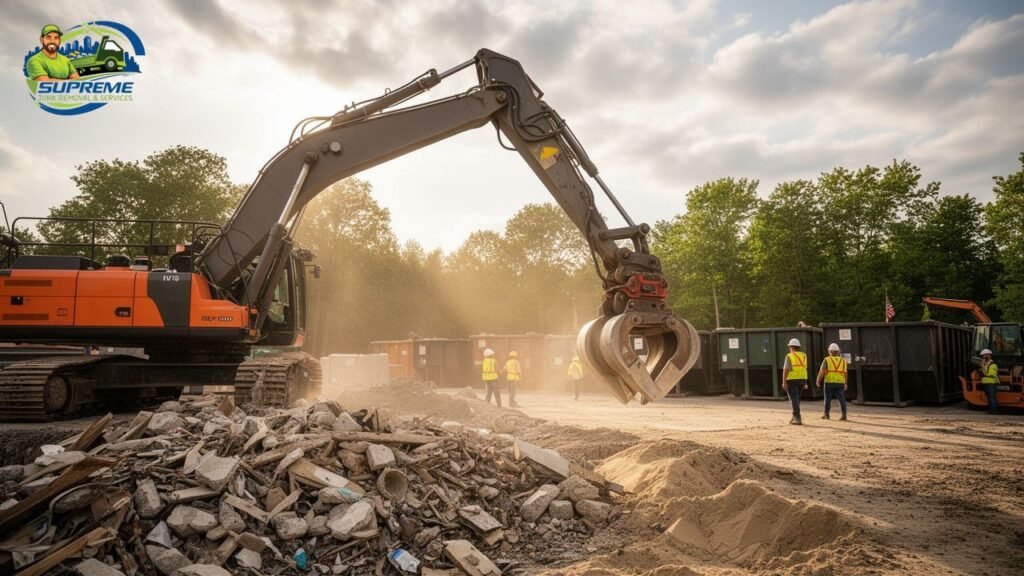
The process begins with a site assessment to determine the volume and type of waste. Materials are categorized into two main streams: commingled debris and source-separated recyclables. Because Massachusetts law prohibits the disposal of many common construction materials in landfills, most loads are hauled to a Construction and Demolition (C&D) processing facility where mechanical and manual sorting occurs.
A standard construction waste removal checklist involves several distinct stages to ensure no material is left behind and the site remains safe for other trades.
Bonus Tip: Use Small Sacks for High-Rise or Attic Work Instead of carrying loose debris down several flights of stairs, use heavy-duty rubble sacks. This keeps the dust contained and makes the final loading into a truck much faster.
Every contractor operating in Auburndale must stay current with state and federal regulations to avoid liability. The Massachusetts Department of Environmental Protection (MassDEP) maintains strict waste bans on materials such as asphalt shingles, pressure-treated wood, and metal. These materials must be diverted to recycling or reclamation centers rather than traditional trash facilities.
Safety is the primary concern during any commercial junk removal service operation. Falling debris, sharp edges, and heavy lifting pose significant risks to workers. Federal guidelines from OSHA require that all scrap and debris be removed from the immediate work area as the work progresses. Keeping walkways and stairs clear is not just a best practice; it is a legal requirement to prevent trip and fall accidents.
| Material Type | Disposal Regulation | Recovery Method |
| Concrete and Brick | MassDEP Waste Ban | Crushing for road base aggregate |
| Clean Wood | MassDEP Waste Ban | Grinding for mulch or biomass fuel |
| Gypsum Wallboard | MassDEP Waste Ban | Specialized recycling for new drywall |
| Ferrous Metals | Highly Recyclable | Scrap metal smelting |
| Hazardous Waste | Special Handling Required | Licensed hazardous waste facility |
In many Auburndale projects, especially those involving kitchen or bath remodels in older homes, there is no room for a roll-off dumpster to sit on the property for weeks. Same day construction debris removal offers a solution by providing “live loading” services. The truck arrives, the crew loads the debris immediately, and the vehicle departs. Because the truck does not remain stationary on the road, this eliminates the need for expensive street permits from the City of Newton and prevents neighbors from filling your dumpster with their own household trash.
For larger commercial developments or multi-unit renovations, the volume of waste requires a more robust strategy. Commercial junk removal services often involve multiple daily rotations of high-capacity trucks. This keeps the site clear for subcontractors like plumbers and electricians who need space to work. When debris piles up, it slows down every other trade on the job, leading to costly delays in the master schedule.
Bonus Tip: Schedule Mid-Week Pickups Mondays and Fridays are the busiest days for hauling companies. Scheduling your removal for Tuesday or Wednesday often ensures more flexible arrival windows and better availability of equipment.
Choosing the right approach for debris removal impacts both the budget and the project timeline. Before selecting a service provider or a disposal method, consider these site-specific and logistical factors:
Contractors often have specific concerns regarding the cost and legality of waste disposal. According to data from the Environmental Protection Agency, construction and demolition debris accounts for a massive portion of the national waste stream, making efficient management a priority for environmental sustainability.
How is the cost of removal calculated? Most services charge based on a combination of volume (the space the debris occupies in the truck) and weight (the actual tonnage of the material). Masonry and dirt are significantly more expensive to dispose of because of their density.
Can all construction materials be recycled? While materials like metal and concrete are highly recyclable, items such as painted wood, certain plastics, and contaminated insulation must typically go to a specialized landfill.
Is a permit always needed for debris removal? If the removal happens entirely on private property with a truck that does not linger, a permit is generally unnecessary. However, any container placed on a street or sidewalk in Newton requires official approval.
Materials like lead-based paint debris, asbestos-containing shingles or insulation, and certain adhesives are considered hazardous. These cannot be placed in a standard debris truck and require a licensed abatement contractor.
A general rule for interior demolition is that every 1,000 square feet of renovated space generates roughly 15 to 20 cubic yards of debris, though this volume varies based on the specific materials being removed.
A roll-off dumpster is a bin left on-site for you to fill over time. In contrast, a hauling service provides the labor to load the truck and removes the debris immediately.
Yes, Newton ordinances typically prohibit loud construction activity before 7:00 AM on weekdays and have stricter limits on weekends. Removals should be planned within these hours to maintain good community relations.
Managing a construction site in Auburndale requires balancing the physical demands of the job with the regulatory environment of the Greater Boston area. By focusing on source separation and choosing the right hauling logistics, contractors can reduce their environmental footprint and avoid unnecessary costs. Supreme Junk Removal & Services understands these local dynamics and provides the expertise needed to keep your project moving without the burden of accumulated waste. Evaluate your specific site needs, consider the volume of material, and choose a removal strategy that aligns with your production schedule and safety goals.
When your project in Auburndale requires immediate attention, reaching out to an experienced team ensures that your site remains compliant and clear. You can contact Supreme Junk Removal & Services by calling (857) 245-8160 or by sending an email to supreme.junkservices@gmail.com. Providing clear information about the types of materials and the site access points helps the team deliver the most efficient service for your job site cleanup needs.