Summarize with
Shed removal takes a shed apart piece by piece and hauls the materials away. Demolition knocks the structure down with power tools and then clears the mixed pile of debris left behind. Both jobs leave you with an empty patch of yard. What changes is the method, the safety risk and the amount of sorting at the end. Our crew handles both through our junk removal and hauling in Auburndale and Newton and the rest of Greater Boston.
It’s common to ask for demolition when the shed is a solid resin kit that would come apart in an hour. It’s just as common to ask for simple shed removal after a February storm has already folded the roof in half. The rest of this guide shows which job your shed actually needs and which Massachusetts disposal and permit rules apply to each one.
The core difference is control. Shed removal vs shed demolition comes down to whether the shed can come apart safely in the order it was built or whether it has to be brought down and sorted on the ground. Industry cost guides put both jobs in a similar price band. The labor just shifts around. Careful dismantling takes more hands-on time but leaves cleaner piles. Demolition moves faster on the teardown and slower on the sorting.
| Factor | Shed removal (dismantling) | Shed demolition (tear-down) |
|---|---|---|
| Best for | Sound sheds and prefab kits | Rotted, leaning and storm damaged sheds |
| Method | Unscrew and unbolt in reverse build order | Cut or pull down then sort on the ground |
| Common tools | Drill, pry bar and socket set | Reciprocating saw and sledgehammer |
| Debris left behind | Whole panels and clean lumber | Broken and mixed material |
| Reuse or relocation | Often possible | Rarely possible |
| Main safety risk | Sharp metal edges and loose roof panels | Sudden collapse and hidden rot |
| Who it suits | Owners replacing or giving away a shed | Owners clearing the space for good |
Try a simple push test. If the walls don’t rock and the floor doesn’t flex, you’re probably looking at standard shed removal. If you wouldn’t stand inside it, you’re looking at demolition. Want the full price picture first? Our guide on how much shed removal costs in 2026 breaks it down by size and material. Thinking about a weekend DIY job instead? Read how to remove a shed before you rent a dumpster.
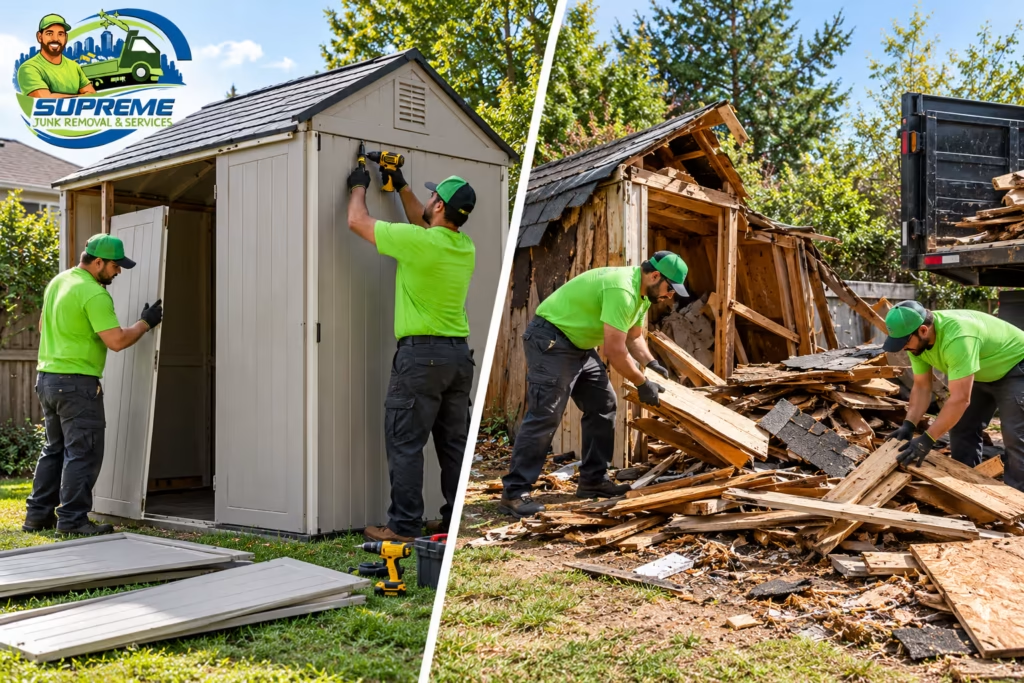
Shed dismantling is the careful version of the job. The crew takes the shed apart in reverse order so the roof panels, wall sections and floor come off mostly intact. That’s why it works so well on prefab kits. A steel Arrow shed is held together with hundreds of small sheet-metal screws. Resin sheds from brands like Suncast and Lifetime lock together at the panel seams and pop apart once the roof cap is off.
Stick built wood sheds take longer because the framing is nailed. Even so the plywood sheathing and 2×4 studs often come out clean enough to reuse. Careful shed removal also keeps an option open that demolition closes for good. A sound 8×10 shed can sometimes be moved to another corner of the lot. It can also be listed for free in a local Buy Nothing group where someone in Watertown or West Newton might happily haul it off whole.
| Tip 1: Take photos of all four sides before you ask for a quote. A clear look at the floor and roofline tells the crew right away whether dismantling is realistic. |
Pick a shed tear-down when the structure can’t be trusted to stay up while someone works on it. Rotted floor joists or a sagging ridge or a roof crushed by snow all point to demolition. New England weather does most of this damage. Plenty of wood sheds in Newton and Belmont sit on patio blocks or bare soil.
Years of wet springs and freeze thaw cycles soak the bottom plate until it turns soft. Then one heavy winter adds enough snow load to crack a rafter. At that point nobody should be standing under the roof unscrewing panels.
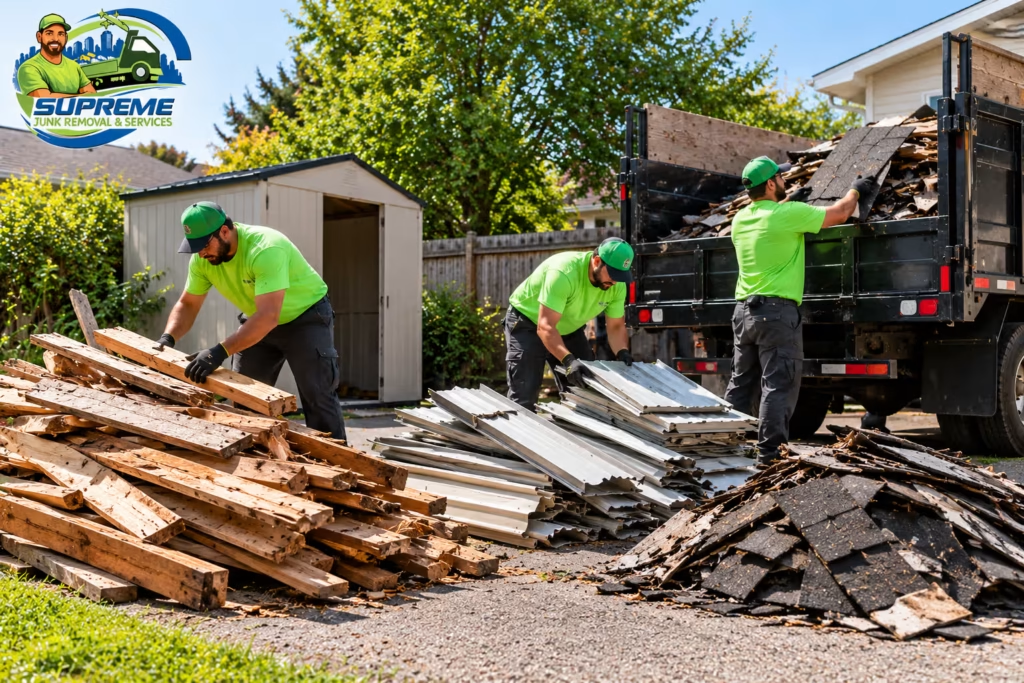
Demolition brings the shed down on purpose and in one direction. The crew cuts it into sections or pulls the walls inward so nothing falls toward the house or the fence. The tradeoff is the pile. You end up with splintered lumber and bent metal and old shingles all tangled together. That pile can’t just ride to a landfill.
The MassDEP waste disposal bans list treated and untreated wood as banned from landfills along with metal, brick, concrete and clean gypsum wallboard. So the debris gets sorted for recycling first. Newton’s curbside hauler won’t take banned materials like metal and brick. Newton residents can drop scrap metal at the Rumford Avenue Resource Recovery Center, though.
Usually not for a typical backyard shed. The state building code (780 CMR) exempts one-story storage sheds of 200 square feet or less from a building permit. Demolition rules are set locally however. Some building departments still want a demo permit or a quick sign-off even on small structures. Call Inspectional Services in Newton or the building department in Waltham before any shed demolition begins. Parts of Newton and Brookline also sit inside local historic districts where an older outbuilding may need a review first.
Asbestos is the bigger concern on older sheds. Cement-board siding and some old roofing products contained asbestos for decades. MassDEP’s asbestos and demolition notification rules require a separate notification for any project that removes asbestos. Abatement can only start after a waiting period of 10 working days. Residential buildings with fewer than 20 units don’t need the general construction notice when no asbestos is involved.
Lead paint is the other quiet risk. The EPA warns that homes built before 1978 may contain lead-based paint. Many sheds in Auburndale and Brookline were painted to match those older houses. Smashing or sanding that paint spreads dust across the yard where kids and pets play.
| Tip 2: Look for flat gray siding panels that feel like stiff cement board. Have a licensed inspector test a sample before anyone swings a hammer if your shed has them. |
|---|
A clean shed removal process runs from the top down in the reverse of how the shed was built. Here’s the order most crews follow.
| Bonus Tip: Rent a rolling magnetic sweeper for the final cleanup. One roofing nail hiding in the grass can flatten a mower tire next spring. |
The shed demolition process trades careful unbolting for speed. Crews brace the structure and cut it into sections or pull it down in one direction. Then everything gets sorted on the ground. Reciprocating saws handle most of the cutting. A sledgehammer and a pry bar knock apart what’s left.
Bigger jobs like a 12×20 workshop with a loft may call for a mini excavator. That only works with a wide enough gate. Many lots in Cambridge and Brookline have side yards too tight for machines, so everything gets cut down to hand-carry size.
The foundation comes next. A shed on a concrete slab needs a jackhammer to break it up and the broken concrete goes to a recycler instead of a landfill. Frozen ground from December through March makes slabs and gravel pads harder to lift cleanly. That’s one reason a lot of homeowners schedule slab work for spring.
Choose demolition over standard shed removal whenever a crew can’t safely work under the roof. The extra sorting time is cheaper than an injury.
The right shed removal service depends on the shed’s condition first and everything else second. These five factors decide which method fits and what the final quote looks like.
| Pro Tip: Ask any crew how they’ll sort the debris under the Massachusetts waste bans. A clear answer tells you the hauler knows where wood and metal actually end up. |
Most problems start before the first panel comes off. Leftover chemicals, live wires and bad disposal plans cause more trouble than the teardown itself.
The three general methods of demolition are mechanical demolition, manual demolition and explosive demolition. Backyard sheds almost always fall under manual demolition with hand and power tools.
Demolishing and removing a 10×12 shed typically costs between $450 and $2000 with a national average around $650 to $1400. A concrete slab or tight yard access pushes the price toward the top of that range.
Professional shed removal typically costs between $250 and $3000 with a national average of around $650 according to guides like Angi. Final prices depend heavily on the size of the structure and the materials used. Breaking up a concrete foundation and local disposal fees add to the total as well.
Sometimes. Dismantling a clean kit shed can cost less because the parts sort easily and some can be reused. A badly rotted shed usually costs more to dismantle because the slow approach isn’t safe.
Yes. Many homeowners keep the slab as a base for a new shed or a small patio. Check it for cracks and heaving first because frost damage is common on older New England slabs.
It comes down to one question. Can the shed come apart safely in the order it was built? If it can, then careful shed removal is the better fit and you might even save the materials for reuse.
If it can’t, then demolition is the safer route and the extra sorting is simply part of the price. Either way, check the shed’s age for lead and asbestos and call your town about permits. Plan the next use of the space before work starts too. Late spring through early fall is the easiest window here because the ground is soft and the days are long.
Our crew handles both careful dismantling and full demolition across Auburndale, Newton, Waltham and the rest of Greater Boston. We empty the shed, take it down and sort the debris for recycling. Then we rake the ground clean so it’s ready for whatever comes next.
Contact Supreme Junk Removal & Services at (857) 245-8160 or email supreme.junkservices@gmail.com to discuss your specific needs. Send a couple of photos with your message and you’ll get a straight answer on which method your shed needs.