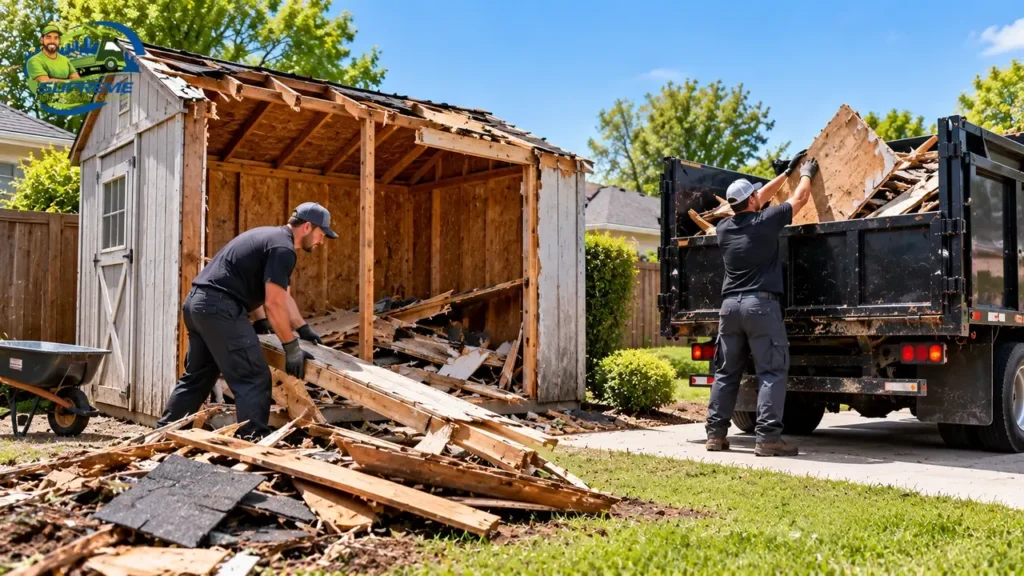
There are four options for shed disposal: Assemble a crew to destroy and remove the shed in one trip; rent a dumpster to tear down the shed; dismantle it and dispose of it yourself. Give the shed away. The choice will depend on the size of the shed, the materials used to construct it, and how many Saturdays you have to spare.
A crew of two can usually drop a backyard shed in two to four hours. Getting rid of the pieces is the harder part. In Massachusetts, the wood and metal can’t go out with your regular trash, so somebody has to sort it and drive it to the right places. Supreme Junk Removal & Services does both halves through its shed teardown and haul away service, right through to raking the lawn after. Planning to do it yourself? Below is how to dispose of an old shed without surprise fees, fines, or a wrecked back.
How to Prepare Your Shed for Disassembly
Remove, unplug, and inspect for specific materials of interest. Skip one of those and a simple teardown can turn into a toxic materials bill.
Start with what’s inside. Paint cans, gas, propane tanks, pool chemicals, and old fertilizer can’t ride in the same load as lumber, and most Massachusetts towns take them on household hazardous waste days. If someone ran a circuit out to the shed, get an electrician to cut it at the panel, and do the same with a water line.
Then take a hard look at the outside:
Gray cement shingles on older sheds can contain asbestos
Wasp nests tend to hide up in the eaves
Skunks and woodchucks like the gap under the floor
Wiring or a footprint over 200 square feet may mean your town wants a permit, so call the building department first
An empty shed with no wiring gets quoted faster, and that’s the cheapest kind of shed disposal there is, since the crew isn’t padding the price for unknowns.
Tip: If the shed is pre-mid 1970s, and has cement shingle siding, it is assumed to be a shed until a lab test indicates otherwise. Avoid breaking, cutting, or power washing the panels.
Comparing Ways to Dispose of an Old Shed
You have four realistic ways, and the cheapest one is rarely the least work. For a typical 8×10 to 10×12 wooden shed, here’s how they stack up.
Option
Typical cost
Your time
Works best for
Give it away or sell it
$0; the buyer hauls it
A few hours of messages and showings
Sheds with a solid floor and a roof that doesn’t leak
Tear it down and haul it yourself
$30 to $150 in dump fees, plus a truck and tools
One or two weekends
Small wood or resin sheds under 100 square feet
Tear it down and rent a dumpster
About $450 to $750 for a 10- to 15-yard container
One weekend, plus loading
People who want to do the labor but skip the driving
Full teardown and haul away
$400 to $800 for most sheds; $249 minimum for small jobs
Under an hour of your own time
Large sheds, slabs, wiring, tight access
Resin sheds or metal sheds that can be easily unbolted typically sell quickly on Facebook Marketplace or a neighborhood Buy Nothing group, and the person who buys it tears it down. This is as close to free shed disposal as you can get. A wood shed with a soft, rotted floor, however, isn’t going to be in demand.
Up to this point, it seemed like a bargain. Until you add up the trips, there it is: cheap DIY. A pickup bed holds maybe a third of a shed, and every run to the transfer station costs money and an afternoon. For a size by size price breakdown, see our guide on how much shed removal costs in 2026. Pick your route before the first nail comes out, because that one call decides most of what old shed disposal ends up costing you.
Where Shed Demolition Waste Goes in Massachusetts
Most shed materials do not go straight to a landfill. Massachusetts rules restrict the disposal of wood, metal, brick, and concrete. So a torn down shed has to be split up by material for proper recycling or disposal.
The rules sit in 310 CMR 19.017 and cover homeowners as much as haulers. Here’s where shed demolition waste usually ends up:
Shed material
Where it ends up
Worth knowing
Framing lumber and plywood
Construction and demolition (C&D) processor or wood recycler
Clean wood can become mulch or fuel
Pressure-treated skids and floor joists
C&D processor
Never burn it; the smoke carries the treatment chemicals
Metal siding, roof panels, hinges
Scrap yard
Some yards pay by the pound
Asphalt shingles
C&D transfer station, kept separate
Heavy, so they drive up the load weight
Concrete slab or piers
Concrete recycler, crushed into aggregate
Banned from disposal in Massachusetts
Doors and windows in good shape
Building materials reuse store
Worth pulling before demolition starts
Somebody has to separate a mixed pile of lumber, metal, and shingles. If you don’t do it in the yard, the transfer station does it and charges you for the labor, which is why sorting is the part of shed disposal people in this state underestimate.
Tip: Make sure to ask any hauler where your debris is going. A legit crew can name the transfer station or recycler. If the answer is vague, you don’t want your old shed turning up in the woods with your address on a scrap of mail inside.
How to Take Down a Shed Step by Step
Start at the top and work down. Remove the roof first, then the walls, and the floor last. This helps prevent the shed from falling on anyone working inside.
Use a pry bar, hammer, cordless drill, reciprocating saw, gloves, and safety glasses. Also, you will need another person, as two people can dismantle a small wooden shed in a day, while one person likely cannot.
Open up doors and windows as well as box any glass elements separately, before anyone grabs them bare-handed.
Remove shingles or metal roof panels, followed by removal of roof sheathing.
Release the rafters one by one as your helper keeps the other end.
Remove it from the siding and cut off the bottom plate’s studs. Keep two walls up to the end to keep the frame braced.
Remove skids and pull up the floor. Underneath, look for rusted nails and wasp nests.
Create separate piles: clean wood, treated wood, metal, shingles, trash.
Run a rolling magnet over the lawn, or your mower will find the nails first.
Step six saves more money than the rest combined. EPA construction and demolition data show demolition makes up more than 90 percent of all C&D debris in the U.S., and just under 145 million tons of it went to landfills in 2018.
Facilities see a lot of mixed junk, so a clean pile moves faster at the scale house and makes shed debris disposal easier to get accepted. Sorted loads also tend to cost less at the gate, which is where DIY shed disposal either pays off or doesn’t.
How Shed Size Affects Removal and Disposal Costs
A small shed is priced in the $250-$450 range, and an average sized 8×10-10×12 will run at $400-$800, including teardown, hauling, and dump fees. Big sheds and anything on concrete cost more.
Around Greater Boston, these are the ranges we quote for shed removal and disposal:
Shed size
Full removal cost
Typical time on site
Small, up to 8×8
$250 to $450
1 to 2 hours
Medium, 8×10 to 10×12
$400 to $800
2 to 3 hours
Large, 10×16 to 12×20
$700 to $1,500
3 to 4 hours
Oversized or on a concrete slab
$1,200 to $3,000+
Half a day to a full day
Size gives you the starting number. After that, access matters, since every extra 50 feet the crew carries debris by hand adds time. A shed still full of junk turns into two jobs, and a slab means a breaker on site plus a heavier load at the dump.
If the shed’s already in pieces, we price by how much of the truck it fills. A quarter load is $429, a half load $679, and a full truck $1,199, with labor and disposal included. You did the hard part, so shed disposal at that point is just loading and driving.
When to Hire a Professional Shed Removal Service
Hire a professional when the shed is larger than 100 square feet, on a concrete slab, has wiring, or is hard to reach because of a fence. Each of those can stretch one weekend into three and a half dozen dump runs.
If you own a pickup and the shed is a 6×8 resin model on gravel, honestly, just do it yourself. You’ll be done by lunch.
Anything bigger, and a shed removal service shows up with a trailer that fits the whole structure, so it leaves in one trip instead of five. The crew sorts the debris too, and that sorting is the piece of shed waste removal most homeowners don’t see coming. When you calculate the cost of the truck rental, dump fees, and your weekend, it’s often not that much more to pay for shed disposal.
Tip: On quote day, take measurements and be aware of the type of ground under the shed (dirt, gravel, or concrete). Those two pieces of information give you a price range over the phone.
Common Shed Disposal Mistakes That Cost More
The most costly one is knocking the shed down before deciding where the pieces go. A jumbled pile of lumber, shingles, and metal in the driveway can cost more to haul than the same shed taken apart and sorted.
We see a few others every season, and most shed disposal budgets that go sideways trace back to one of them. People burn the lumber, even though Massachusetts open burning rules cover brush and not building materials, and most shed floors are pressure treated anyway. Others leave the shed full for the crew to find, which is how a $600 quote becomes $900 on site.
Then there’s the slab. Decide early if it will remain as a patio, will serve as the foundation for a new shed, or will be taken away. If the siding could be asbestos, then don’t cut into it and get it tested first. Put the order in place and dispose of the sheds in one visit, rather than taking a month.
Frequently asked questions
How can I get rid of my old shed?
If it’s still firm, sell or donate it. If not, take it down and take the parts to a transfer station or hire someone to take it down and go to the transfer station. After dump fees and a dump truck are paid, the costs of hiring out are typically just a few dollars higher than the cost of the shed once it exceeds 100 sqft.
What do you do with an old shed?
Reuse what you can and recycle the rest. Doors, windows, and hardware can go to a reuse store, framing to a wood recycler, and metal to scrap. A shed that’s still sound can also become a chicken coop or a potting shed.
How do I get rid of my shed?
Empty it and check whether your town wants a permit. After that, decide whether you’re doing the labor or booking a crew, since that choice drives everything else.
How much does it cost to destroy a shed?
Most sheds cost $400 to $800 to tear down and haul away. Small ones start around $250, and large sheds or sheds on a concrete slab run $1,200 to $3,000 or more. Doing it yourself mostly costs dump fees of $30 to $150 per load.
Do you remove sheds in Newton and nearby towns?
We do. Our crew is based in Auburndale and covers Newton, Waltham, Weston, Needham, Belmont, Brookline, Cambridge, and Boston.
Will you take the junk that’s still inside the shed?
Most of it. When you call, just be sure to say Gasoline, propane, or Pool Chemicals, as these are not permitted in the same load as the wood.
Can you remove the concrete slab too?
Small slabs, yes, as an add on. Tell us during the quote so we bring the breaker.
Are you insured?
Fully. We also put down ground protection before the first panel comes off, which keeps fences and garden beds in one piece.
Conclusion
Determine the path, triage the coming and going, and route each material to where Massachusetts needs it. The space cleared can be a garden bed or a new shed pad in a weekend, and if you do shed disposal first, then garden, it doesn’t often cost more than you had anticipated. If the frame has already shifted, or the roof has begun sagging, do not use the sledgehammer and obtain an estimate before anyone goes inside.
Clear Your Yard With Professional Shed Removal
If you’d rather not lift a board, Supreme Junk Removal & Services will tear it down, sort it, haul it, and rake up after. Call (857) 245-8160 or email supreme.junkservices@gmail.com for a free quote.