

Turnover week costs more than any other week in a property manager’s year. The average apartment turnover lands somewhere around $3,872 per unit, and the typical multifamily unit sits dark for about 41 days before someone new signs.
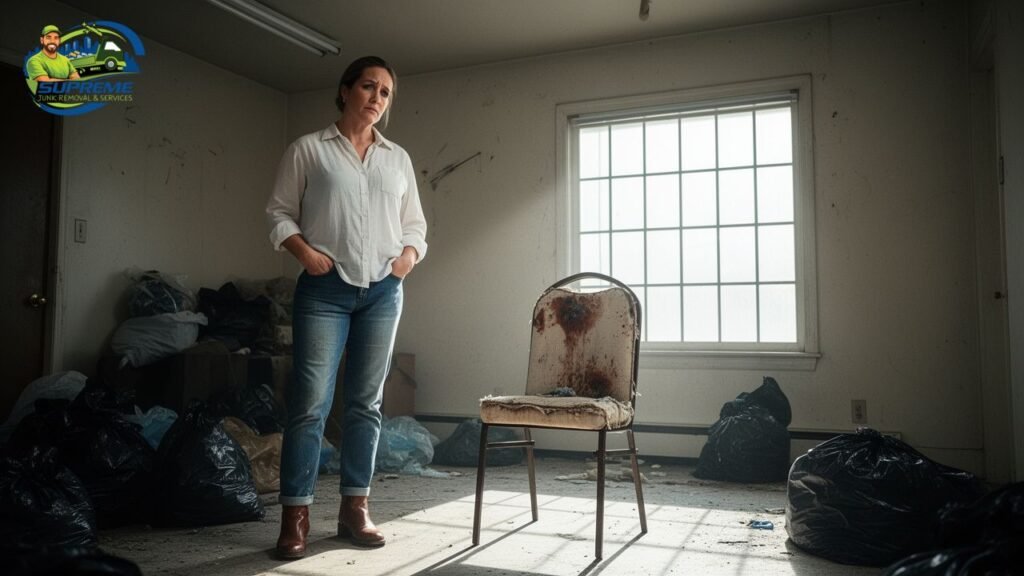
Ask ten managers where those days went and nine of them will say paint or flooring. It’s usually something less interesting: a living room full of whatever the last tenant didn’t feel like carrying down the stairs.
That’s the first domino, and commercial junk removal services are how most teams knock it over before the rest of the schedule starts sliding. The volume behind this isn’t small either. Americans throw out more than 292 million tons of municipal solid waste a year, per the U.S. Environmental Protection Agency, and a fair share of the couches and refrigerators in that number came out of somebody’s rental.
Understanding how property managers handle apartment cleanouts starts with the calendar and the paperwork, not the dumpster.
Newer managers tend to learn this the expensive way. A unit that looks abandoned isn’t automatically yours to empty. Once a resident gives notice or an eviction closes out, the first thing to confirm is that possession has legally transferred, and if there are still belongings inside, most states treat them as protected personal property for a set number of days.
How many days depends entirely on where the building sits. Washington makes you hold a tenant’s belongings at least 45 days before disposal. Upon expiration, 30 days of storage is mandated by Nevada statute followed by a 14 day disposal notice. California has a 18 day period from the date of a notice of abandonment. Which is how a normal job of cleaning up rooms becomes a wrongful disposal lawsuit, when a manager who has rooms in Reno and Tacoma runs two separate clocks on the same job.
Once the clock runs out, document it. Photos of every room, inside the closets, behind the fridge, plus a written inventory of anything that looks like it has value. Boring, and it’s saved plenty of managers in small claims court.
Then the hauling starts, and this is where in-house teams hit a wall. One maintenance tech handles a light turn fine. He is not getting a sleeper sofa down three flights alone, which is why full-scale apartment cleanout services exist as their own line item.
Now stretch that across forty units turning in the same six weeks and you’ve got the whole category of property management cleanout services. Most managers we work with keep commercial junk removal services on retainer for exactly that reason, so a crew rolls out the day a unit clears instead of the following month.
The apartment turnover cleanout process
The apartment turnover cleanout process follows a fairly predictable order once possession is secured. Walkthrough first, sorting everything into three piles: worth donating, tenant property that still needs storing, and plain garbage. Then the haul-out, room by room. Deep clean. The make-ready inspection closes it and releases the unit for listing.
Speed isn’t a vanity number here. At a national average rent near $1,740, an empty day costs you about $58. A well-sequenced make-ready takes three to five days, and the sharpest operators get it down to 72 hours by stacking trades back-to-back, which only works if the place is empty when the first one shows up.
That part gets underestimated constantly. A sofa runs 100 to 200 pounds. A mattress, 60 to 100. A half-furnished two-bedroom fills a truck without much trouble, and none of it moves while a painter stands in the doorway checking his phone.
Booking commercial junk removal services for day one is less about the junk than about protecting every crew scheduled behind it.
What items are removed during cleanouts
Knowing what items are removed during apartment cleanouts helps you size the truck before anyone shows up. It is almost always furniture, primarily sofas, mattresses, bed frames, dressers, dining sets. Then come the appliances: laundry, window AC, refrigerators and dryers.
Then the long tail no one plans for, a bagged trash and dead electronics, carpet off-cuts, half-empty paint cans, and everything else that’s been left out on the balcony since spring. (Chest freezers are their own special problem. Still plugged in is bad. Unplugged for three weeks is worse.)
Some of this has a real second life. Appliance metals recycle well, and furniture in decent shape goes straight to a local charity rather than a landfill.
The numbers on the rest are bleak. Americans generated roughly 12.1 million tons of furniture and furnishings in a single year, and only 0.3 percent of it got recycled while about 80 percent went to landfill, per the EPA’s durable goods data. Zero point three percent. For a category made mostly of wood and steel, that’s a strange thing to sit with. A hauler who actually sorts for donation and recycling trims your disposal bill and keeps a few couches out of that figure.
What’s included in a rental cleanout
Scope is a different question from the item list. When managers ask what is included in a rental property cleanout, what they really want to know is where the invoice stops. A full-service job covers the labor, the hauling, the sorting, disposal fees, and usually a broom-clean finish at the end.
Decent providers quote the whole job instead of pricing per item, and they handle the dump run and the recycling drop themselves, so nobody on your staff ever sees a landfill scale.
Insurance and permits matter more than they sound like they should. Paint, tires, batteries, and certain electronics can’t legally go in a regular bin, and when that goes wrong the fine attaches to the property, not to the guy who dumped it.
(Technically the owner eats it. Practically, the call comes to you.) That’s the unglamorous reason managers keep the same commercial junk removal services on speed dial portfolio-wide instead of rebidding every turn.
When to schedule a rental cleanout
The honest answer to when should property managers schedule a cleanout is the day notice is given, not the day keys come back. Starting the work during the notice window rather than after move-out is one of the few levers that actually pulls vacancy days down.
There’s a scheduling reality underneath that too. Turnover clusters hard in late spring and summer when leases roll, and national apartment turnover rates run 45 to 60 percent a year, so every property on the block is calling the same haulers in the same stretch of weeks.
Book in June for a July move-out and you get the window you want. Call on move-out morning and you get whatever Thursday afternoon nobody claimed. Booking commercial junk removal services early skips that scramble.
Preparing a rental for new tenants
An empty unit is the starting line, not the finish. Knowing how to prepare a rental property for new tenants means getting from empty shell to repairs to paint to final inspection without dead air in between.
The order that works: haul everything out, patch and paint, sort the flooring, deep clean, then walk the punch list. Make-ready repairs alone average about $1,800 a unit, and every hour a paid crew spends working around a stack of somebody’s old dishes eats into that.
There’s a leasing argument too, since units that photograph clean rent faster. That’s how a 41-day average starts inching toward the 72-hour benchmark the best operators hit.
Benefits of professional cleanout services
The benefits of hiring a professional property cleanout company land in three separate places on the P&L, which is usually why the math works out. Speed is the obvious one, since two trained guys empty a unit in an afternoon.
Liability is the one owners actually care about, because an insured hauler carries the risk when somebody throws out a back or puts a mattress in the wrong container. The third gets overlooked: documentation. Providers worth using log what came out and where it went, and that record has settled more than one deposit dispute.
Predictable pricing belongs on the list as well. The junk removal industry pulled in over $10 billion in a recent year with commercial work taking a growing share, and that kind of competition keeps flat-rate quotes honest for repeat clients.
Set that against paying a maintenance tech’s hourly rate to fight a refrigerator down a stairwell, which is slower and, if he gets hurt, a great deal more expensive.
Across a portfolio it compounds. For Supreme Junk Removal & Services clients, having reliable apartment cleanout services on call means fewer stalled turns in August, and bundling property management cleanout services means one vendor and one invoice rather than chasing five haulers across five buildings. Which is roughly how commercial junk removal services went from an occasional expense to a standing line in most turnover budgets.
Your Trusted Partner in Commercial Junk Removal
Ready for a clutter-free workplace? Supreme Junk Removal & Services delivers fast, dependable commercial junk removal tailored to your business needs. Don’t let clutter slow you down — call (857) 245-8160 or email supreme.junkservices@gmail.com today for a free quote and same-day service!
Frequently asked questions
Do you offer apartment cleanout services in my area?
Supreme Junk Removal & Services covers apartment and rental cleanouts across its local service region. If your building is inside our coverage zone then we can usually get a crew out in a day or two, and same-week booking is normal outside peak season. Send us the property address and we will confirm.
How fast can a crew reach a property near me?
Depends on how far you are from our nearest dispatch point and how full that week already is. Properties in our core service area usually see next-day or same-week windows. Call when your tenant gives notice instead of after they’ve gone and you’ll get first pick of times.
Are your local haulers licensed and insured?
Yes. Every crew carries the hauling permits and liability coverage required for your municipality, and follows local dumping and recycling rules. Keeps disposal fines off the property, and you’re not exposed if something goes sideways during the haul-out.
Where do you take items removed from local rentals?
Everything’s sorted before it goes anywhere. Furniture in usable condition goes to nearby donation partners, metals and appliances go to recyclers, and only genuine waste ends up at the landfill. Lower disposal costs for you, and fewer reusable goods dumped into a waste stream that’s already overloaded.
How much does a rental property cleanout cost?
Most haulers price by truck volume rather than per item, so a studio runs a fraction of what a fully furnished three-bedroom does. Either way the cleanout is a small slice of the total turnover figure, which averages close to $3,872 per unit once repairs, lost rent, and leasing costs are counted.
What items are removed during apartment cleanouts?
Furniture, mattresses, appliances, electronics, carpet remnants, bagged trash, general clutter. Hazardous materials like paint, solvents, batteries, and some electronics go through separate disposal channels rather than the regular load.
When should property managers schedule a cleanout?
The day your resident gives notice. Starting during the notice window instead of after move-out shortens the vacancy, and at roughly $58 per empty day on an average-rent unit, that head start tends to cover the cost of the job by itself.
Can you handle an eviction or abandoned-property cleanout?
Yes, as long as possession has legally transferred and any required storage period has run out. Those windows range from about 18 to 45 days depending on the state, so confirm your local timeline and we’ll schedule around it.
Sources
- U.S. Environmental Protection Agency, National Overview: Facts and Figures on Materials, Wastes and Recycling.
- U.S. Environmental Protection Agency, Durable Goods: Product-Specific Data (furniture and furnishings).
- Nevada Revised Statutes, Chapter 118A, Section 118A.460 (disposal of abandoned tenant property).